

By: Vesna Tomašević |
Sprouts - live food for perfect health |
|


 Sprouts are the best food you can grow yourself. Their incredible nutritional content makes them indispensable in the diet of people who tend to achieve perfect health.
The benefits of sprouts are mentioned in the Bible, in the Book of Daniel. They were popular in China over 5000 years ago - the doctors used to prescribe them for the treatment of many diseases.
Today we see an increase in popularity of germs, due to their affordable price and nutritional value.
You can grow them yourself, using the seeds of the plants - for example, sunflower seeds, broccoli, cabbage and carrots. It is also possible to achieve germination of legumes and nuts.
Their beneficial effects on health can be seen quickly, and studies have uncovered the reason behind their many benefits.
Specifically, the content of nutrients increases manifold via germination
Nutritional value of germs
Vitamins
Vitamin content dramatically increases during germination. This is especially true for vitamins A, B, C and E. The vitamin content of some seeds, cereals, legumes and nuts can grow 20 times during germination.
Fatty acids
The content of essential fatty acids also increases during germination. Most people have a deficiency of essential fatty acids. Regular consumption of sprouts easily solves this problem.
Fibers
And the fiber content of legumes, nuts, various seeds and grains significantly increases germination. The fibers are the most important for digestion and weight loss, because they bind to fats and toxins in our body and facilitate their removal.
Enzymes
The sprouts can be up to one hundred times more richer in enzymes than fresh fruits and vegetables. Enzymes are special types of proteins that act as catalysts for all bodily functions. The quality of protein in legumes, nuts, seeds and grains improves the moment when they germinate.
Minerals
During germination minerals bind to the protein, which allow our bodies to absorb them more efficiently. This is true for alkaline minerals such as calcium, magnesium, iron, potassium and manganese. Thanks to alkaline minerals germs alkalize human body. Many diseases, including cancer, have been linked with excess acidity in the body.
How to grow sprouts at home
Growing sprouts is a great way to provide access to quality fresh food all year round. When you grow your own sprouts you do not consume unwanted pesticides, additives and other chemicals that are harmful to health.
One of the better methods of farming is the use of a wide-mouthed glass jar and a lid for sprouting from the health food store, or gauze and rubber instead of the cover. Use only organic seeds for germination.
Make sure that you choose the seed from a reputable supplier who can guarantee that the seed was not subjected to radiation or heat treatment, because this process prevents germination.
What can germinate
Nuts:
almond, hazelnut, peanut
Seeds:
flax, sunflower, sesame
Legumes:
soybeans, chickpeas, mung dal, peas, lentils
Grains:
wheat, quinoa, buckwheat, kamut, rice, corn, oats, rye
Vegetables
broccoli, cabbage, carrots, onions, spinach, lettuce, celery, cabbage, beets, radishes
Wash your hands before handling seeds.
First, remove all damaged seeds or those that have changed color, then stones, twigs or shells that could be found in the seed. Put only one type of seeds in each individual jar.
Speaking about the amount of seeds, use one teaspoon of seeds or a half cup of legumes or grains. They will increase in size and volume during soaking and sprouting process.
Pour clean water over the seeds. If you put a few tablespoons of the seeds, cover them with at least one cup of water.
If you use legumes, nuts and grains, pour at least three times the amount of water compared to the quantity of seeds.
Close the container lid with germination lid or gauze. If you are using cheesecloth, secure it with a rubber band.
Rinse seeds several times a day. Make sure to drain them appropriately every time you rinse them.
Germination time varies for each variety. In the table below you can see the time of germination for some types of grains and vegetables as well as water quantity.
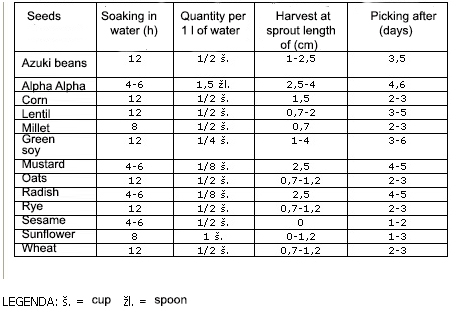
When the sprouts are ready for harvest, put them in a large bowl with cold water and stir to separate shells and skins from seeds.
They will usually emerge to the top so you can remove them. But you do not have to worry about removing every single little shell.
Strain them well. They are now ready to use!
You can store them covered in the refrigerator for about a week to 10 days, depending on the type of germ.
Advice
To increase the mineral content of seeds add a little seaweed and other algae in the water while the seeds are still soaked in water.
The healing properties of sprouts
Alfalfa sprouts are recommended for adults and children. They prevent osteoporosis, cancer and heart disease.
Mung bean sprouts cleanse the body of toxins and strengthen liver function.
Almond sprouts increase vitality and are very tasty.
Broccoli sprouts are true mineral-vitamin bombs. They help to prevent the formation of several types of cancers.
Pea sprouts help stabilize blood sugar levels, while lentil sprouts strengthen the heart and immune system.
Wheat sprouts stimulate the metabolism and eliminate stress. They can also be consumed by children.
Quinoa, oats and rye sprouts strengthen immunity, while radish sprouts have anti-inflammatory activity.
Chickpea sprouts strengthen the pancreas, stomach and heart.
Sprouts can be eaten as a separate course or they can be added to many dishes. You can add them to salads, soups and vegetable dishes.
Be sure to add them to dishes at the end, because heat treatment will destroy their nutritional properties.
Liked the article?
Share it with your friends!


