

By Ana Marija Pšeničnik |
Turn your home or office into an oasis of calm and health with the help of diffusers |
|


 As we are getting less and less immune to cold and flu with the approaching cold weather, we realize that diffusers can be of great help in inhalation with breathing problems.
Aromatherapy diffusion is the process of diffusing essential oils so that their aromas slowly fill the room or space with their natural scent.
Today there are many different methods for the diffusion of essential oils in spaces.
Provided that you got a high quality, pure essential oil, you can create a simple aromatherapy session in your own home with everyday objects you already have.
For long-term effects, however, you will need a professional device for diffusing the oil.
Simple methods of diffusing essential oils
Diffusion with the help of a linen cloth
Add 3 to 4 drops of the essential oil of your choice to a linen cloth and place it somewhere nearby.
Every time you take a step or make another move, the scent will enrich the air in the room.
This method is quick, readily available and idea for use in public spaces (ex.: at work or in vehicles during longer trips) because it doesn’t emit a large quantity of the aroma into the air and keeps the scent moderate.
Unfortunately, the effect is spatially limited and fairly short-lived.
Steam diffusion
Boil two cups of water.
Pour the water into a bowl and add 10 drops of essential oil. If you opt for an plant with an intense aroma, such as cinnamon, rosemary, thyme, eucalyptus or similar, add fewer drops of the essential oil.
The steam method can be used at any time of the day or night, depending on whether or not you want an energizing or relaxing effect.
The steam will heat up the oil and cause it to quickly evaporate in the space. However, the aroma achieved with this method is not long-lasting.
Further, heat can change or destroy certain characteristics of the essential oil, which means its therapeutic effect cannot be optimal, as when using cold air methods.
More complex methods of using essential oils
Aroma lamps

They are used with a tiny candle which gently heats the essential oil and diffuse it into the room. These are normally made out of ceramics or metal and they are very popular.
They contain an opening or space where you put the candle and a bowl in which you put a small amount of essential oil.
They exist in many shapes and colors and can be modest and functional or look like proper works of art.
Pour a small amount of water into the bowl and add some drops of the oil.
The positive side to using this method of diffusion is its low price. Also, it doesn’t require any electricity.
The drawback is the need to continually use and replace the little candles. As with the other methods which use a heat source, the therapeutic effects are reduced because of the heating.
Diffusers made of terracotta and sand stone
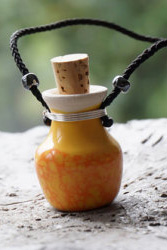
Passive terracotta diffusers (that is, baked stone) and sand stone diffusers are available in the market in various sizes and shapes.
Certain terracotta diffusers look like clay bowls which take small quantities of essential oil.
They are usually closed with corks.
The oil seeps through the entire jar and diffuses into the space outside. The intensity of the aroma depends on how much oil is used.
Clay jars are cheap and they don’t need any electricity sources. The drawback to this method is keeping the aroma levels in the air constant.
The scent is strongest not long after adding essential oil to the bowl and then it disappears as time moves on.
Lamp ring diffusers
Lamp ring diffusers are normally made of terracotta or brass. They are shaped like a ring and are placed directly onto a standard light bulb.
They have a grooved lip that goes all the way around them where you put the essential oil. The head from the light bulb heats up the oil and gently diffuses it into the room.
Advantages of this type of diffuser:
The advantage is its low price.
But it can be awkward to use because it best suits traditional, round light bulbs without shades or with shades with an opening on top.
Also, you need to be careful when adding essential oils because just one drop which happens to end up on the surface of a light bulb can cause it to burn out.
The heat is a negative factor when it comes to preserving the quality of the oil’s composition.
Electric diffusers
Traditional diffusers
They are normally made of wood, glass or rubber. They most often resemble small candles with wooden base and elongated glass top.
It’s not uncommon for them to really serve as lighting because of the additional LED lighting.
They are turned on with the help of electricity but they don’t lead to heating so the micro particles of the essential oils are not damaged.
They are often quiet and have adjustable levels of diffusion. They are simple to use and it’s not necessary to add water.
Fans
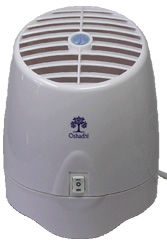
Fans for diffusing essential oils are produced in various sizes, shapes and styles.
These diffusers work by blowing essential oil into the air. Fan diffusers have pads or trays which are changed from time to time.
You add drops of oil to them and place them in their spots in the fan, then turn it on.
Fans spread the aromas throughout the entire space by blowing air through the pad to which oil has been added.
Depending upon the size of the diffusers, some are made for smaller spaces, and others are big enough to cover large areas.
It’s not necessary to clean the fans and they are simple and safe to use. Sometimes they are available with batteries, which makes them easy to move around.
Their advantage is that they don’t involve any heating, so there is no change in the aroma or loss of healing properties of the essential oils.
The down side is having to buy replacement pads for soaking up the oil. Also, some fans can be noisy.
Electric heat diffusers spread aromas throughout the room by heating them up.
The often work well in larger spaces and are an excellent choice for wooden essential oils such as sandalwood and patchouli.
There are also small wall diffusers which are plugged directly into the wall. They have short diffusion cycles and are suitable for smaller rooms.
Sometimes diffusers have the option of emitting discreet lighting while being plugged in.
A drawback of such diffusers is the heat separating the components of the oils and causing oxidation.
Ultrasound diffusers

There are also ultrasound diffusers available in the market in attractive, modern shapes.
With the effect of ultrasound vibrations, they diffuse micro particles of the oil, creating an aromatic fog.
essential oils are added to them with water so often, aside from sterilization, they humidify the air and are ideal for apartments with central heating.
They have various programming options and depending on the price they can have various added features such as LED lighting or filtered lighting, an alarm clock and radio or connectivity with music sources.
The down sides are that they are fairly pricy (from 400 to 1800 HRK) and the heating method they often use to diffuse the particles.
Nebulizers
Nebulizers also work according to the principle of ultrasound. They are devices which receive essential oils and which break them down into separate molecules before diffusing smaller molecules into the space.
Such small molecules are believed to be more easily absorbed into the lungs and enable a better health effect than any other method of diffusion.
Nebulizers are smaller devices made up of two main parts – a plastic base or foundation which contains a motor and an unusual glass element which resembles a flower or crooked jug where the oil goes and where nebulization is performed.
Sometimes the air pump from the base is connected to the glass jar where the oil goes through external tubing.
The devices use a system of cold nebulization which preserves the quality of the essential oils, offering an effective therapeutic effect.
Depending on the type and price, individual nebulizers can be complicated to clean after use, and the glass part can break.
Some types of nebulizing diffusers are not appropriate for woody oils (sandalwood, patchouli) because they can clog the device.
Practical application
Inhalation for respiratory illnesses
When you have a cold or flu or are dealing with a cough, essential oils such as pine, juniper, tea tree, cypress, eucalyptus, lemon or mint can help
Aside from eucalyptus, bergamot, myrtle and sandalwood can work as expectorants.
If you have a bronchi infection, in addition to the already mentioned oils, ginger, cloves and frankincense will also be effective.
For sinus infections try basil, rosemary or thyme.
Aside from strong tea tree oil, eucalyptus and lemon, geranium and lavender will help you fight viruses.
Morning essential oils and work
If you have difficulty waking up or getting energized for work, citrus oils will get you moving (grapefruit, lemon, tangerine, sweet orange).
Make use of the effects of peppermint, which helps when you’re feeling fatigued or unmotivated, that is, when you need an extra dose of energy.
Relaxation and sleep treatment
The ideal choice of a multi-functional oil is lavender, which relaxes you and makes you sleepy.
Also, it successfully chases away insects.
For problems with insomnia, chamomile and cardamom are also excellent.
Bergamot de-stresses, as does sandalwood, which reduces tension and encourages relaxation.
Sources used include:
[url=http://www.aromaweb.com]http://www.aromaweb.com[/url]
[url=http://www.terra-organica.hr]http://www.terra-organica.hr[/url]

Liked the article?
Share it with your friends!


