

|
 By Dr. Lejla Kažinić Kreho
Healthy Food: The Safest, Cheapest and Most Accessible Drug |
|


"Our most intimate connection to the outside world is food."
This is a sentence worth emphasizing, and one I have included in my book which describes metabolic syndrome – "The 21st Century Diet".
Rheumatoid arthritis, diabetes, hypertension, obesity, Alzheimer’s disease, various psychological issues… all the aforementioned disorders are in direct correlation to that which you put on your plate.
Poor food choices can, in time, lead to your demise.
The entire 20th century was behind us by the time, scientists had finally acknowledged food as a powerful means of affecting overall health.
Today, many scientific studies confirm the power of certain types of food.
If a certain therapeutic food is ingested often, the usage of synthetic medications can also be reduced and even eliminated altogether.
So, what are these natural ingredients which have been proven to help with the potentially fatal metabolic syndrome, which, if untreated, leads to type 2 diabetes and cardiovascular diseases which include heart attack and stroke?
What should one use to also help with many other acute and chronic states?
Acquaint yourself with the most affordable, safest, and most accessible drug there is – food.
Alfa-Lipoic Acid – Natural Remedy Number 1
Alfa-lipoic acid is surely the natural remedy number 1 for metabolic syndrome and diabetes. For the treatment of these disorders, it has proven itself a star ingredient.
What exactly is alfa-lipoic acid? It is a fatty acid which is found in smaller doses within our bodies, and which turns glucose into the energy we require.
It was isolated in a laboratory for the first time in 1951, and the last few decades have seen much investigation of its powerful effects of prevention and alleviation of metabolic syndrome.
At the beginning of the 1920s, the German government approved the usage of alpha-lipoic acid for the treatment of diabetic neuropathy, a severe nerve impairment accompanied by feelings of numbness, pain and burning sensations.
Today, numerous scientific studies have confirmed the many useful characteristics of this super-antioxidant.
Not only does it help with diabetes, but also with forgetfulness, cancers, thyroid disorders, Lyme disease and chronic fatigue, and has proven effective in the treatment of many eye conditions such as glaucoma and cataracts.
Since 2009, it has found a place on the list of important natural ingredients I make mention of in my books, especially when speaking of pre-diabetes and diabetes.
Are there any foods especially rich in this fatty acid?
Of course: broccoli, yeast, spinach, potatoes.
How exactly does it work?
This powerful antioxidant stimulates the utilizing of glucose in the muscles.
A normal dose in the form of a nutritional supplement would be one 100 mg pill daily, while people suffering from metabolic syndrome could be aided in reversing their metabolic syndrome by ingesting 200 mg daily.
At the 200 mg daily dosage, it prevents nerve and kidney damage in those with diabetes. Up to five weeks is the time frame believed necessary for improvement of symptoms.
A therapeutic dose for diabetic neuropathy is from 600 to 1,200 mg, but administration of dosages this high must be supervised by a professional.
It helps with reduction of blood sugar. Therefore, be careful if you are on a diabetic therapy plan as its interaction with medication can lead to hypoglycemia.
Cinnamon – A Medicinal Spice and Enemy of Diabetes
We’ve known it as a fragrant spice for over 2,000 years.
It comes from the bark of the cinnamon tree, its botanical name Cinnamomum zeylanicum.
There are two types of cinnamon: ceylon and cassia. In stores, you will most often find Chinese cinnamon (cassia), because of its price. This cinnamon contains large amounts of coumarin – a compound which can be harmful to the liver and kidneys.
Unlike the Chinese type, Ceylon cinnamon is absolutely safe.
This spice positively affects the regulation of glucose in the blood and cholesterol.
In a study published in the Diabetes Care magazine in 2003, those with type 2 diabetes ingested from 1 to 6 grams of cinnamon (1 g is equivalent to half a teaspoon) over the course of 40 days.
Pakistani scientists (Khan et al) concluded that the cinnamon lowered blood sugar levels up to 24 percent, and cholesterol around 18 percent.
A German study from 2006 (Mung et al) indicated a positive effect of cinnamon on blood sugar, as did an American study from 2009 (Dr. Paul Crawford), which demonstrated a significant reduction of glycosylated protein HbA1c.
Measurement of this protein in the blood of people suffering from type 2 diabetes showed that the blood sugar levels were regulated within a few weeks or months.
The therapeutic dose is half a teaspoon daily, which acts so as to enhance the body’s ability to utilize insulin.
However, if you are already taking diabetes medication, consult with a doctor and carefully monitor your blood sugar levels, so as not to induce hypoglycemia.
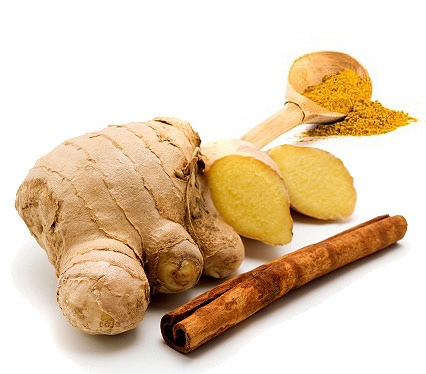
Ginger – The Indispensible Super-Root!
The many positive effects of ginger and curcuma are well-known. That is why I have included them in my book My Mediterranean Diet, despite their not being typical Mediterranean spices.
Seeing as how they are very easily available today, I have used them to complement a nutritional approach I believe to be the healthiest.
What makes ginger so healthy?
Thanks to the bioactive components of gingerol, shogaol, and zigeron, ginger is today known for its anti-inflammatory and strong anti-oxidant action.
Ginger possesses anti-inflammatory and anti-hypertensive properties, which makes it the ideal ingredient when dealing with metabolic syndrome.
Does ginger have anti-cancerogenic properties?
Yes, studies have shown that 6-gingerol, an antioxidant more powerful than vitamin E and one responsible for the taste of ginger, caused reduction of the mass of tumors in mice to which it was administered, as opposed to those which did not receive it.
In cases of ovarian cancer, it caused apoptosis – a state of programmed cell destruction, as well as autophagy – a state in which cells digest or rather destroy themselves.
New studies conducted by scientists at the Institute of Human Nutrition at Columbia University (Mansour M. S. et al, April 2012), show that a warm ginger drink affects accelerated calorie burning as well as a feeling of fullness in obese men at risk for metabolic syndrome.
The study was conducted on two control groups, one of which drank the ginger drink with breakfast.
The study demonstrated that the group drinking the warm drink had increased thermogenesis – the increase in body temperature necessary for the efficient burning of calories and a prolonged feeling of satiety.
This illustrates the possibility of ginger being one very simple, practical and affordable weight loss aid.
Who should exercise caution with increased ingestion of ginger?
Only people who are already taking blood thinners should be cautious. As ginger possesses such properties itself, it can interact unfavorably with existing therapy plans.
Curcuma – The Yellow-Orange Spice Fascinating Scientists
Curcuma, a member of the ginger family originally from India and China, has fascinated scientists with its protective effects on our body.
With studies performed on mice, scientists have proven that curcuma halts lung metastases in breast cancer cases. They have discovered that it can help with the production of taxol – a treatment for breast cancer which would be more effective, yet less toxic.
Curcumin – the active element in curcuma facilitates the liver’s detoxification process, or rather the removal of toxins. This helps the body to more efficiently release the bad LDL cholesterol.
People suffering from metabolic syndrome who also report excess weight issues surely have problems with their joints, with some already having developed arthritis.
This super-spice is one of the main ingredients in nutritional therapy, with omega-3 essential fatty acids treating arthritis, and studies repeatedly confirm its anti-inflammatory properties.
It is unlikely you will find yourself in an Indian house scarce on curcuma, and facts released by the World Health Organization confirm that illnesses such as cancer and arthritis are less frequent there.
In Chinese medicine, curcuma is called jiang huang, and it is known to affect the meridians of the spleen, stomach and liver.
Curcuma’s active ingredient has proven effective in preventing multiple sclerosis, stomach ulcers, Alzheimer’s disease, many digestion disorders, as well as carpal tunnel syndrome.
Simply put, it would appear that this super-spice is very effective at expelling harmful substances from the body.
Use curcuma daily – mix a teaspoon of powdered curcuma with a bit of extra-virgin olive oil and a little black pepper to enhance its absorption.
You can take it as an extract, at 1.5 g daily.
Use curry or curcuma to flavor soups, salads, or boiled vegetables, and enjoy a serving of health right on your own plate.
Liked the article?
Share it with your friends!

